
Monday, November 3rd, at the prestigious Théâtre des Champs-Élysées, the curtains rose to reveal Silvia Costa's new production of Berlioz's 'La Damnation de Faust.' This much-anticipated event marked the inaugural production under the new leadership of Baptiste Charroing. However, despite the buzz, the reception was tepid, with booing heard from the audience as the curtain fell for intermission.
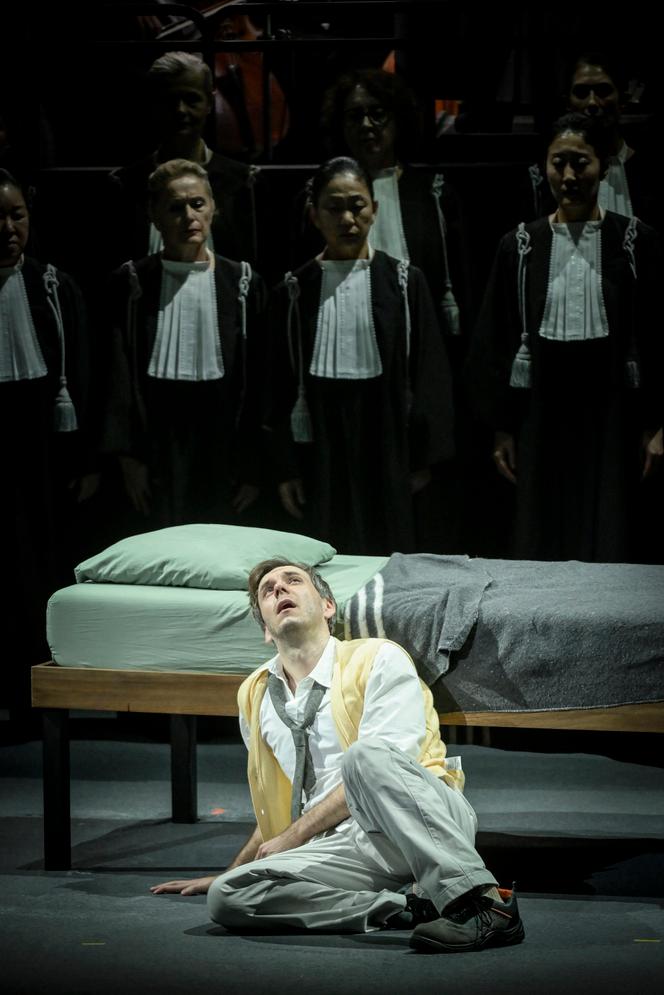 Benjamin Bernheim as Faust in 'La Damnation de Faust,' directed by Silvia Costa at Théâtre des Champs-Elysées, Paris.
Silvia Costa, known for her exploration of complex narratives and memories, might have taken a gamble too far with Berlioz’s hybrid and visionary masterpiece. The production was greeted with barely concealed disappointment, as the audience's verdict remained firm and unyielding. The artists, including the acclaimed tenor Benjamin Bernheim in the role of Faust, were met with a mix of reserved applause and outright jeers at the final bow.
Bernheim's portrayal of the titular Faust was one of the few highlights, bringing a nuanced understanding and vocal agility to the demanding role. Yet, his efforts were not enough to salvage the overall production's reception, suggesting that the direction rather than the performances was where things went amiss.
Jakob Lehmann, leading the orchestra Les Siècles, also struggled to elevate Costa’s ambitious take on this 'dramatic legend' by Berlioz. Known for its sequence of contrasting bucolic, devilish, and amorous scenes, the opera challenges both directors and ensembles, demanding a fine balance between narrative and musical brilliance.
Costa’s attempt to address Berlioz’s 'faustmania', inspired by Goethe's writings, led to a performance strewn with symbolic visions. However, these allusions, intended to evoke the mythic and the monumental, were met with confusion and criticism, rather than the intended awe.
As the production progresses, one cannot help but question whether Costa's interpretation was too abstract or simply misaligned with audience expectations. The trial-like scenes featuring musicians dressed as judges and lawyers did not resonate as perhaps envisaged, leaving viewers yearning for more coherent storytelling rather than abstract artistry.
While the production's shortcomings were evident, the promise shown by Bernheim and the talented musicians of Les Siècles underlines potential yet untapped. Despite this setback, Costa and her team have shown resilience, willing to push boundaries in opera, albeit this time the risk did not coincide with reward.
The Théâtre des Champs-Élysées has long been a hallmark of artistic excellence, and it is expected that future productions will strive to learn from and build upon such critical receptions, aligning both vision and execution to enchant its discerning audiences once more.